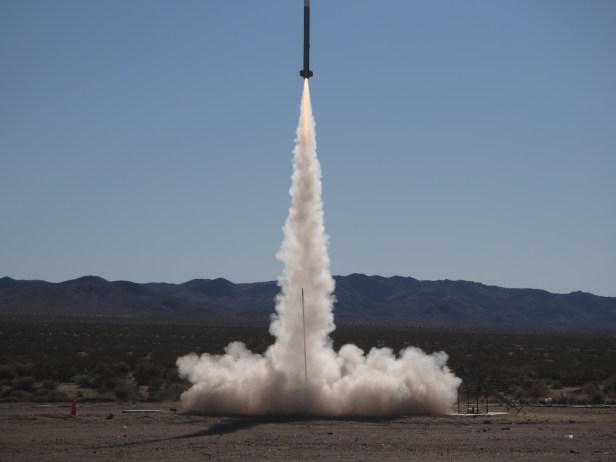
Details about my experiences with Sonoma State University’s Rising Data flight recorder can be found here.
Rocketry Blog Entries
Windy.com — A Complete Weather Visualization App
For years, I used Windy.com to visualize wind patterns at various levels of the atmosphere for my high altitude balloon and rocketry launches. I also use it at sea level while sailing. It is the best app for both use cases. I recently learned Windy now visualizes almost any weather parameter you can think of…
NASA TechRise Student Challange Now Open
The NASA TechRise Student Challenge is open and accepting entries from sixth through 12th-grade teams until November 3, 2025. This year’s challenge invites student teams to submit science and technology experiment ideas to fly on a Virgin Galactic suborbital-spaceship or World View Enterprises high-altitude balloon. Sixty winning teams will receive $1500 to build their experiment, a spot to test…
NAR Educational Resources
The National Rocketry Association has numerous educational resources available. However, many are located beneath a pull-down menu. I hope you can find them from this link: https://www.nar.org/educational-resources/
NASA Adventures in Rocket Science Educator Guide
This 178 page guide contains 25 activities designed for 4-H Clubs, Boys and Girls Clubs, Boy Scouts, Girl Scouts, after-school programs, and other informal education venues (K-12). Participants learn about the history and principles of rocketry and NASA’s newest rockets. While doing these hands-on activities, participants also learn about Hero Engines, parachutes and surface area,…
Friends of Amateur Rocketry hybrids and liquids student rocketry competition – June 7-10, 2024
FAR-OUT is a grassroots, first-of-its-kind hybrid and liquid rocket tournament being held by the Friends of Amateur Rocketry group in the Mojave Desert, California. The event starts with a conference on June 7th in partnership with the Mojave Air & Space Port, where teams will be showcasing their designs via a poster session and podium…
National Association of Rocketry offers its college members $2000 & $3000 Scholarships
NAR members between the ages of 17 and 22 attending college or vocational school may be eligible to receive a $2000 scholarship. Young women majoring in STEM fields are eligible for a $3000 scholarship sponsored by the Estes family. And teachers who uses model rocketry in the classroom may apply for a $500 Robert L.…
Check out the Mach 5 Low-down website.
Mach5lowdown is the only place that specifically covers highly technical and ambitious amateur and student rocketry projects. Updates are posted frequently on individuals and teams all across the planet, showcasing the progress and successes from early concept to launch and recovery. It’s a great resource for rocketeers – advanced and aspiring. https://www.mach5lowdown.com/
NASA Student Launch Proposals Due Sept 19, 2022
Each year, NASA sponsors a year long, student launch challenge for colleges and middle / high school students. Students need to design, build and fly a high powered rocket that reaches an altitude between 4,000 and 6,000 feet. (This would be considered a Level 1 HPR using Tripoli or NAR classifications – well within the…
X-Bow Systems — 3D Printed Suborbital Solid-fueled Rocket Engines
The latest issue (#179) of The Orbital Index featured a picture of X-Bow Systems first test flight. Orbital Index described the rocket (the BOLT) as “retrofuturistic”. I agree and think it will make for a great model rocket design. In fact, X-Bow’s entire fleet (pictured here) makes for great model designs. More interesting, X-Bow main…
NASA TechRise Winners Announced
The NASA TechRise program challenged middle and high school students to design and build experiments for either a high altitude balloon or a suborbital rocket. Today the 57 winning teams were announced here: https://www.futureengineers.org/nasatechrise Note sometime in the future, clicking on the student’s project name will display a page displaying information regarding the project. So…
Unique Components for your Avionics Bay
The September / October issue of Sport Rocketry contained a article on making a Modular Avionics Bay (pg 35). The author used components by three small speciality companies that may prove useful in future high powered rockets: Rocket Junkies (rocketjunkies.com) machined the metal bulkheads (custom) and provided the ejection charge wells (off-the-shelf) for the drogue…
Water Bottle Rockets
I never thought much about water bottle rockets until I viewed a YouTube video on their use in Shields Lab’s virtual summer camp. https://www.youtube.com/channel/UC5Zqx5QCe5b41CcZeWL003g The camp uses Adafruit’s Circuit Playground Express for numerous coding projects and on day 5, the “launch” the CPEx as a flight recorder on a bottle rocket. Since many schools will…
 Fredric Raab